

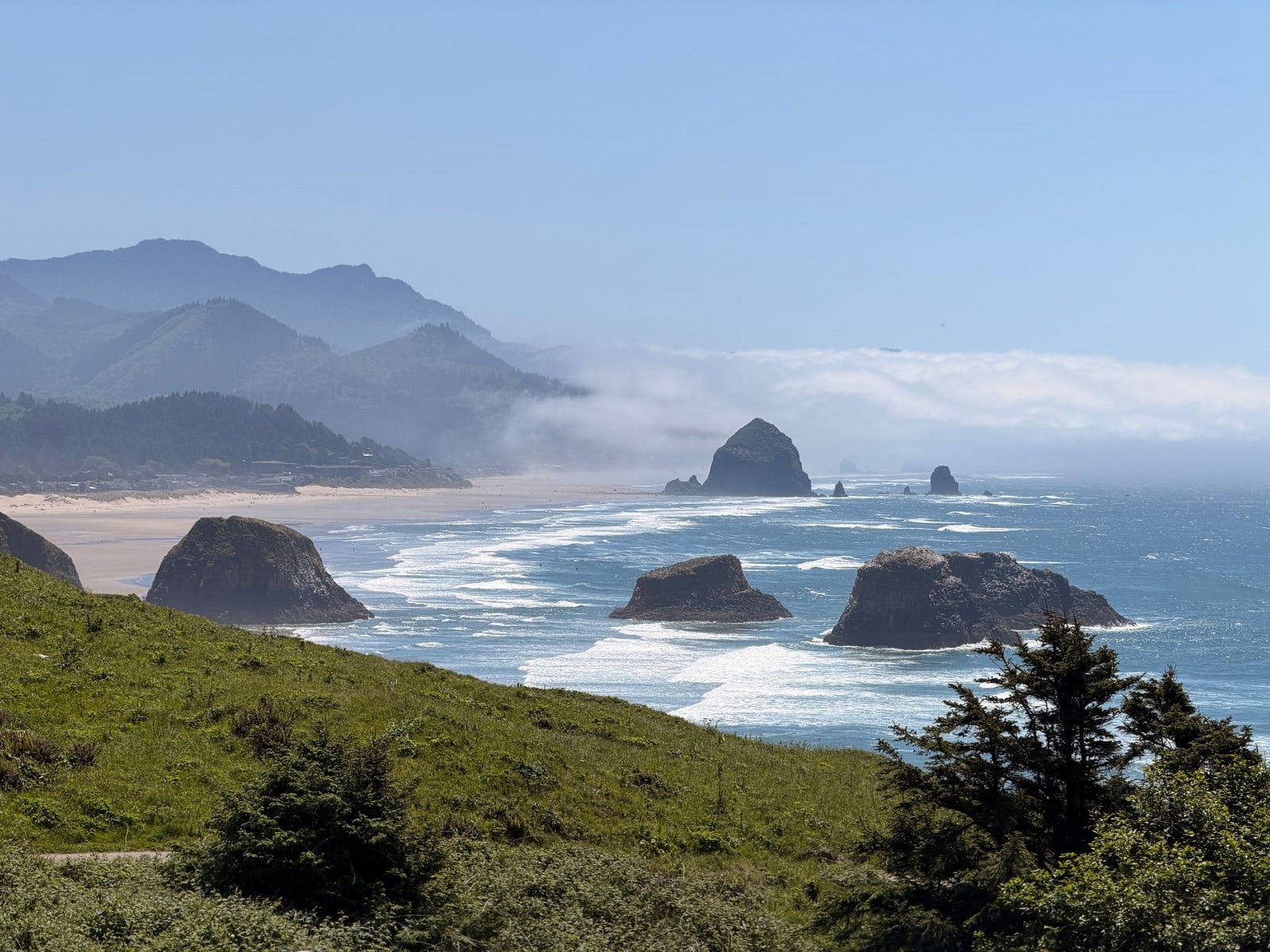
The Oregon Coast rarely presents itself all at once.
Long before the shoreline comes into view, the landscape begins to hint at its presence. Dense spruce forests crowd the roadside. Moist air drifts inland from the Pacific. The terrain rises and falls in gentle folds before ending abruptly at the sea. Even after reaching the coast, broad views are often interrupted by the very features that define the region: forested headlands extending into the ocean again and again along the length of the shoreline.
These headlands shape much of the experience of traveling here. They divide the coast into a series of smaller landscapes—coves, beaches, overlooks, rocky points, sheltered bays, and stretches of open shoreline that appear suddenly before disappearing from view once more. Unlike coastlines that reveal themselves in a single sweeping panorama, this one unfolds gradually.
A viewpoint may offer miles of ocean in both directions. Around the next bend, the road slips back into forest. A broad beach appears at the base of a cliff, only to vanish behind another wooded ridge a few miles farther south. The coastline is almost always present, though seldom in full view.
Fog contributes its own rhythm. Some mornings begin with headlands emerging only as dark shapes beyond the surf. Sea stacks stand offshore like distant silhouettes. By afternoon, sunlight may break through and reveal details that were invisible only hours before—wind-shaped trees, rocky shelves, and long stretches of sand below. The same landscape can feel entirely different depending on the weather moving across it.
The result is a coast defined as much by concealment as revelation. The headlands create anticipation. Each one obscures part of the shoreline while promising another view beyond it. Traveling here becomes a sequence of discoveries. The landscape is rarely hidden, but it is constantly rearranging itself.
The most distinctive stretches of the Oregon Coast are often found where these elements meet. Forest grows nearly to the edge of cliffs. Ferns and moss thrive only a short distance from crashing surf. Sitka spruce lean toward the ocean while sea birds circle the rocks below. The boundary between forest and coastline is often surprisingly narrow. Rather than existing as separate environments, they overlap and intermingle.
This relationship gives the region much of its character. The coast feels like a place where land and sea are constantly negotiating space. Forest advances toward the water. Waves carve into the land. Headlands extend outward. Beaches gather in protected coves between rocky points. The landscape appears active, shaped by forces that remain visible in nearly every direction.
Even in the busiest seasons, there are moments when this geography becomes the dominant presence. Travelers stand quietly at overlooks. Families make their way down trails toward beaches hidden below cliffs. Photographers wait for shifting light to reveal a distant sea stack. Conversations pause as attention turns outward toward the horizon. The landscape has a way of drawing focus back to itself.
To understand the Oregon Coast, it helps to begin with these recurring forms. The towns, beaches, and viewpoints each have their own identity, but the headlands provide continuity. They shape what can be seen, where roads can travel, and how the coastline is experienced. More than a backdrop, they are the framework upon which the region is built.
— - —
Traveling this stretch of coast also means adjusting to its rhythm. Movement here is rarely fast, even when distances on the map appear modest. The road curves around headlands, passes through small towns, and rises unexpectedly to viewpoints where the horizon opens without warning. A drive that looks straightforward on paper often becomes a slower, more interrupted experience in practice.
Part of that comes from the structure of the coastline itself. Highway 101 does not simply trace the edge of the Pacific. It weaves in and out of forest, crosses rivers just before they reach the sea, and pulls inland when cliffs or coves leave little room for a road beside the water. At times the ocean feels close enough to define every mile. At others it disappears entirely behind trees, hills, or a row of weathered buildings in a harbor town. The road repeatedly alternates between exposure and enclosure.
That pattern gives the region much of its momentum. A traveler may spend ten minutes moving through dense evergreen forest, then emerge at a turnout where the land falls away and the coastline suddenly reappears in full. A broad beach may lie just beyond a bluff, invisible until the road reaches the right angle. The effect is subtle, but it is constant. The coast keeps reintroducing itself.
Because of that, pullouts and short stops become part of the region’s rhythm. Some are formal viewpoints with a railing and room for several cars. Others are little more than widened shoulders where two vehicles can pause without blocking traffic. People step out, lean against a door or hood, look for a few minutes, and continue south or north until the next interruption in the trees suggests another view worth stopping for. Even a brief drive begins to feel punctuated by these pauses.
The weather contributes to this rhythm as much as the road. Conditions shift quickly enough that one section of coast may feel open and bright while another, only a few miles away, sits under low cloud and mist. A beach visible from a headland in late morning may disappear behind fog by afternoon. Wind picks up near exposed points, then drops again in sheltered coves or river mouths. Light rarely stays fixed for long. The landscape can seem quieter, sharper, softer, or more distant depending on what the weather is doing at that hour.
This creates a different pace of travel than many destination-oriented trips. The coast does not invite efficiency. It resists being reduced to one or two scenic stops before moving on to the next town. The route itself asks for attention. The steady changes from one mile to the next are part of what defines the place. Forest gives way to cliff. Cliff gives way to harbor. Harbor gives way to open beach. Then the road disappears into trees once more.
The small towns scattered along the coast reinforce that pattern. They feel woven into the landscape rather than separate from it. A bridge crosses a bay or river mouth. A few blocks of storefronts appear, along with cafés, fish markets, weathered motels, and parked trucks carrying kayaks or surfboards. Harbors gather working boats and gulls. Then, often just as quickly, the road narrows again and the forest returns. Towns feel less like interruptions to the coastline than brief concentrations of life within it.
This is part of what makes the Oregon Coast feel connected even across long distances. The individual places vary in size, geography, and character, but the movement between them follows a familiar pattern. There is almost always another headland ahead, another stretch of trees pressing close to the road, another overlook where the coast briefly opens into view. Travelers begin to recognize the sequence even when the scenery itself changes.
The region’s identity also depends on the meeting of forest and ocean in unusually close quarters. On some coastlines, beaches dominate the experience. On others, cliffs or built-up waterfronts define the edge of the land. Here, the forest remains a constant presence. Sitka spruce, shore pine, salal, sword ferns, and moss continue almost to the shoreline in many places, giving the coast a density and softness that changes the feel of the Pacific edge. Even exposed overlooks often have trees at their backs.
That contrast matters. The Oregon Coast can feel expansive when viewed from a bluff or wide beach, but it rarely feels empty. There is too much texture, too much vertical layering between forest floor, roadside, cliff edge, surf, and offshore rock. A traveler is often aware of several landscapes at once: the dark tree line behind them, the grasses and shrubs at the bluff’s edge, the movement of waves below, and the silhouettes of sea stacks farther out. The coast is visually busy in a way that broad sandy shorelines are not. It asks to be looked at in layers rather than in a single glance.
Those layers become especially visible in the quieter moments between destinations. Someone walks back to their car with a paper cup after standing at an overlook for ten minutes longer than planned. A family carries towels and a cooler down a trail toward a beach hidden below the road. A couple in rain jackets studies a map at a turnout while fog lifts enough to reveal the next headland offshore. At a harbor, people wait near a fish market window while gulls circle overhead and charter boats rock against the dock. The human presence is steady but rarely overwhelming. Much of it feels temporary, shaped by weather, tide, and the simple act of stopping to look.
This may be the clearest difference between the Oregon Coast and other scenic coastlines in the West. It is experienced in intervals rather than in one continuous sweep. Forest closes in around the road, then gives way to a headland or beach, a harbor town, a bridge crossing a river mouth, and another stretch of shoreline beyond it. The pattern repeats with variations for hundreds of miles, giving the region both its coherence and its unpredictability. After enough time on the road, the coast begins to feel less like a collection of stops than a connected landscape shaped by weather, forest, and sea.
— - —
That sense of connection may be what lingers most after several days on the Oregon Coast. Individual places certainly stand out—an overlook above a field of sea stacks, a beach reached by a steep path through spruce and salal, a harbor town where fishing boats rock against the dock beneath a line of gulls. But the stronger impression is often the way these places relate to one another. They do not feel isolated, or interchangeable, or arranged as a checklist of stops. They feel like variations within the same landscape.
The headlands are part of what creates that continuity. So are the forests pressing close to the road, the river mouths widening just before they meet the Pacific, and the repeated transition from enclosed stretches of highway to sudden open views. Even the weather contributes to the sense that the coast is one connected environment rather than a sequence of unrelated destinations. Fog that softens one headland in the morning may lift by afternoon farther south. Wind moves through exposed bluffs and quiet harbors alike. Rain darkens the pavement, the tree trunks, the driftwood, and the cliffs with the same gray sheen.
Seen this way, the Oregon Coast feels less defined by any single landmark than by its recurring patterns. The shape of the land matters as much as the names on the map. A traveler may remember a particular beach or town, but they are just as likely to remember the repetition of forest and bluff, the constant presence of water just beyond the trees, or the way the road keeps circling back to the Pacific after disappearing inland for a few miles. The region’s identity is cumulative. It builds through repetition, variation, and the gradual recognition of what keeps returning.
That may be why the coast can feel both familiar and unpredictable at the same time. The larger pattern becomes recognizable long before the details do. Another headland appears ahead. Another turnout opens toward the sea. Another town gathers around a harbor or river crossing before the road slips back into the trees. Yet each stretch still carries its own weather, light, scale, and texture. The rhythm remains recognizable, even as the scenery keeps changing within it.
After enough miles, the individual viewpoints begin to blur together in the best possible way. The coast feels less like a sequence of destinations and more like a continuous landscape shaped by forest, weather, and sea. The headlands remain the constant—revealing one stretch of shoreline, concealing the next, and giving the journey its rhythm.
Guide Note
This Region is intended as a portrait of place rather than a travel guide. It focuses on the character, landscape, and experience of the Oregon Coast as a connected region.
Further Exploration
This Region offers an introduction to the Oregon Coast as a connected landscape. Future pieces in Stay Notes will explore individual stays and memorable excursions within the region, while companion Hearthline guides will provide deeper regional context, planning insights, and exploration ideas for those ready to experience the coast firsthand.
Continue Reading
If this portrait of the coast leaves you wondering where to linger, our next Stay settles into the quiet coastal town of Yachats, where forest, ocean, and everyday life meet at an unhurried pace.
Planning Your Journey
A Thoughtful Guide to the Oregon Coast - Hearthline ↗
Practical guidance for choosing where to stay, understanding the regions of the coast, and planning an unhurried journey.